international
Christmas Lights and Pakistan’s National Colors Light Up Washington with a Message of Love and Harmony
10mo ago • Dec 14, 2025, 12:53 PM • Updated 2mo ago
4 min read
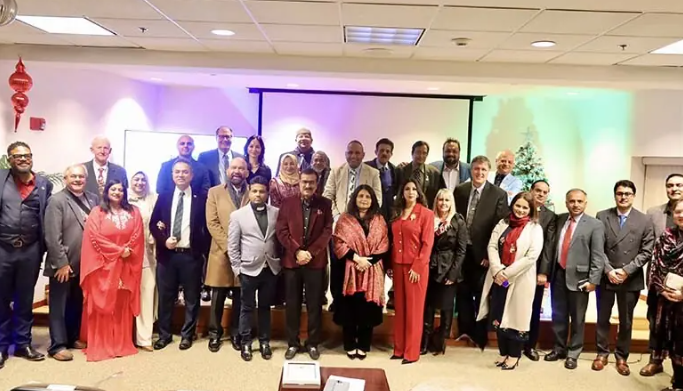
The grand hall of the Pakistan Embassy in Washington, D.C. glowed with festive warmth on Saturday evening as Christmas celebrations blended seamlessly with Pakistan’s green and white, creating a powerful visual and emotional statement of unity, faith, and belonging.
Red and gold Christmas decorations adorned the venue, while Pakistan’s unmistakable green appeared throughout the hall — in flags, ribbons, lapel pins, and softly shimmering white lights that echoed both the holiday season and the crescent-and-star symbol of the nation many guests still proudly call home.
The pre-Christmas interfaith gathering, hosted for Pakistani Christians, members of the Pakistani diaspora, and local community leaders, opened and closed with a resounding chant: “Pakistan Zindabad.” Far from ceremonial, the words were spoken with conviction — a reflection of lived experience, identity, and enduring attachment to the homeland.
A Tradition of Interfaith Unity in Washington
Speakers highlighted that for over twelve years, the Pakistan Embassy has hosted similar events bringing together Muslims, Christians, Hindus, Sikhs, and Jews, nurturing a quiet but resilient tradition of interfaith harmony that has endured political turbulence, social divisions, and global uncertainty.
A message from the Governor of Virginia commended the embassy’s sustained efforts to promote religious pluralism and encouraged continued initiatives that strengthen community ties across faiths.
Dr Srilekha Palle, advisor to the Virginia governor, spoke of India and Pakistan as neighboring societies “so much alike,” expressing hope to visit Pakistan. She emphasized that love for one’s country is inseparable from faith itself, noting that patriotism rooted in inclusion reflects a deeper spiritual commitment.
Faith Without Hierarchy, Patriotism Without Exclusion
Several speakers echoed this theme, underscoring that faith should never divide citizenship. Pakistan’s Deputy Ambassador Batool Qasim described the dinner as a long-standing tradition aimed not only at celebrating Christmas but at welcoming Christian brothers and sisters and their neighbors into a shared Pakistani space.
She noted that visits to Pakistan by members of the Christian diaspora often become moments of rediscovery — encounters that challenge stereotypes, move beyond headlines, and reaffirm belonging within the national story.
“This is a time for reflection,” she said, “on what went wrong, and how the coming year can be better — for everyone.”
Recognizing the Role of Minorities in Pakistan
Speakers repeatedly stressed that pluralism and interfaith harmony are not foreign concepts, but integral to Pakistan’s national fabric. The contributions of Pakistani Christians to education, healthcare, and national defense were acknowledged not as acts of charity, but as historical facts and sources of collective pride.
One speaker noted that Pakistani Christians living abroad often serve as an unrecognized bridge between Pakistan and the West, carrying narratives of both hardship and hope.
Discussions also touched on minority rights protection, proposed legislation on minority commissions, and the need to translate words into meaningful legal and social safeguards.
Prayers, Dialogue, and a Shared Future
Pastor John Nuzum of the Church of the Holy Spirit offered a prayer blessing both Pakistan and the United States, while a representative from the Jewish-Islamic Dialogue Society of Washington emphasized the importance of sustained interfaith dialogue — especially in times when identity is increasingly weaponized.
Throughout the evening, the atmosphere remained deliberately warm. The reds and golds of Christmas blended with Pakistan’s green and white, mirroring the central message repeated throughout the night: faiths may differ, but citizenship should not.
As the gathering concluded, the chant rose again — unprompted, confident, and defiant: “Pakistan Zindabad.”
It came from voices shaped by grief, accusation, and silence — from people who, despite everything done to them and sometimes in their name, continue to claim Pakistan as their own.
Under Christmas lights and national colors, that claim felt both ordinary and extraordinary.
“Please feel our attachment to Pakistan,” said event organizer Ilyas Masih. “Despite subzero temperatures, every seat in this large hall is occupied, and people are standing along the sidelines.”