North Korea Says US ‘Hostile Policy’ Unchanged, Vows to Strengthen Nuclear Force | ChatZyr
By Editorial Desk | Team ChatZyr
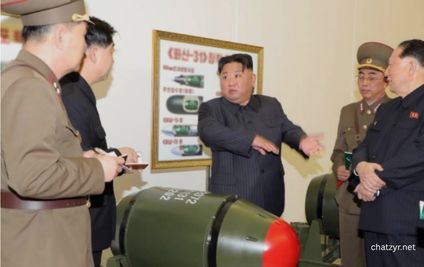
North Korea has accused the United States of maintaining an unchanged “hostile policy” towards Pyongyang, declaring that it will continue strengthening its nuclear force despite President Donald Trump's public signals that he wants to revive diplomacy with North Korean leader Kim Jong Un.
In a statement carried by state media outlet KCNA, a spokesperson for North Korea's Foreign Ministry said Washington had reaffirmed what Pyongyang considers a confrontational approach through its continued demand for the country's complete denuclearisation, criticism of its human rights record and military cooperation with South Korea and Japan.
“The Trump administration has thus fully reconfirmed its invariable hostile policy,” the spokesperson said, accusing Washington of threatening North Korea's sovereignty, political system and security interests.
The statement makes clear that, despite recent efforts aimed at reducing tensions, the fundamental divide between Washington and Pyongyang remains firmly in place.
Nuclear weapons an ‘absolute guarantee’
North Korea said its nuclear arsenal was an “absolute guarantee” for protecting its sovereignty and security.
The Foreign Ministry spokesperson insisted that repeated calls from Washington for the country's denuclearisation would not weaken North Korea's determination to retain its nuclear status.
Pyongyang has repeatedly rejected international demands to abandon its nuclear weapons programme, arguing that its arsenal is necessary to defend the country against external threats.
The latest statement also offered little hope for an immediate improvement in relations with Washington.
According to the spokesperson, expectations of easing regional tensions were “pointless”, while North Korea's policy towards the United States remained unchanged.
Trump signals interest in renewed diplomacy
The statement comes despite Trump's public efforts to create space for possible renewed engagement with Pyongyang.
Earlier this month, Trump ordered a major scaling back of the annual Ulchi Freedom Shield military exercises involving the United States and South Korea.
Trump cited his “very good relationship” with Kim Jong Un and said the exercises were costly and could send an unnecessarily hostile signal to North Korea.
The reduction was widely seen as an attempt to lower tensions and potentially create room for renewed diplomacy.
Trump has also publicly signalled interest in holding another meeting with Kim.
The two leaders previously met three times between 2018 and 2019, producing historic diplomatic encounters but ultimately failing to reach a lasting agreement on North Korea's nuclear programme.
Their diplomacy generated global attention but collapsed over deep disagreements about denuclearisation, sanctions relief and the future of North Korea's nuclear arsenal.
Reduced drills have not changed Pyongyang's view
Despite the scaling back of the US-South Korea exercises, North Korea continues to view military cooperation around the Korean Peninsula as evidence of a hostile American policy.
Kim Yo Jong, the influential sister of North Korean leader Kim Jong Un, said earlier this month that the exercises remained provocative and aggressive even after their scale and duration were reduced.
Her comments highlighted one of the biggest obstacles facing any future diplomatic breakthrough.
Washington may reduce the size of military drills, but Pyongyang continues to see the broader military alliance between the United States and South Korea as a direct threat to its security.
For North Korea, the problem is therefore bigger than a single military exercise.
Another major exercise is approaching
Regional tensions could face another test in September.
The United States, South Korea and Japan are scheduled to hold the Freedom Edge exercise from September 7 to 11, according to Seoul's military.
The trilateral exercise is intended to improve coordination against nuclear and missile threats.
North Korea has repeatedly condemned such military drills, describing them as a threat to regional security.
The United States, South Korea and Japan have increasingly strengthened security cooperation amid concerns over North Korea's expanding nuclear and missile programmes and wider regional tensions.
For Pyongyang, however, that growing military cooperation reinforces its argument that it faces increasing pressure from Washington and its regional allies.
Diplomacy faces the same old obstacle
The latest statement shows that the fundamental disagreement between Washington and Pyongyang remains unresolved.
The United States continues to support the complete denuclearisation of North Korea.
North Korea insists that its nuclear weapons are essential to its sovereignty and national security.
That gap has repeatedly blocked diplomatic progress.
Trump's previous meetings with Kim created hopes of a historic breakthrough, but negotiations ultimately failed to produce an agreement on dismantling North Korea's nuclear programme.
Now, despite Trump's signals of interest in renewed diplomacy and the reduction in some military exercises, Pyongyang is making one thing clear:
Its fundamental position has not changed.
A warning from Pyongyang
North Korea's latest message suggests that reducing the scale of military exercises alone will not convince Pyongyang that Washington has abandoned what it describes as a hostile policy.
The country says it will continue strengthening its nuclear force while rejecting calls for unilateral denuclearisation.
That leaves any future Trump-Kim diplomacy facing the same difficult question that ended their previous negotiations:
Can Washington and Pyongyang find a compromise between America's demand for denuclearisation and North Korea's determination to retain its nuclear weapons?
For now, the two sides remain trapped between fundamentally opposing positions.
North Korea says reducing military exercises will not change its view of Washington as hostile, while the United States continues demanding denuclearisation — leaving diplomacy stuck in the same dangerous deadlock.
Why it matters: North Korea's latest statement signals that efforts to reduce the scale of some US-South Korea military exercises have not changed Pyongyang's fundamental position. With the Freedom Edge trilateral exercise involving the United States, South Korea and Japan approaching, tensions surrounding North Korea's expanding nuclear and missile programmes remain a major challenge for regional security.
Disclaimer: This report is based on publicly available statements and credible reporting available at the time of publication. Claims and positions attributed to governments and officials are presented as their stated views and do not independently establish their accuracy.
Published on Chatzyr.net
Written By Editorial Desk | Team ChatZyr